

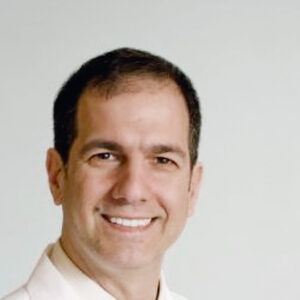
 John S. Pezaris, Ph.D., is the principal investigator and director of the Visual Prosthesis Lab in the Department of Neurosurgery at Massachusetts General Hospital and an assistant professor of Neurosurgery at Harvard Medical School. With degrees in computer science from MIT, a doctorate in computational neuroscience from Caltech, and a post-doctoral fellowship in neurobiology at Harvard, since 2007 Pezaris leads a team developing a thalamic visual prosthesis, a groundbreaking brain-machine interface to correct acquired total vision loss.
What inspired you to explore deep brain stimulation as a means of restoring functional vision to the blind?
As with many things in science, the original motivation was mostly serendipity. While working as a post-doc with Prof. Clay Reid at Harvard Medical School, we used fine electrical stimulation of a brain area called the lateral geniculate nucleus (LGN) to subtly interfere with normal vision, so that we could understand the different signal paths in fine detail and understand more about how we see. That study confirmed that the more complicated visual responses of cells in the primary visual cortex were built from combinations of responses from cells in the LGN.
But then, we thought, does this electrical interference we are using actually create a visual experience, or is it too unnatural, too different from normal input from the eye? So, we trained a macaque monkey to tell us the answer.
Our goal is to provide vision that approaches the threshold of legal blindness
Now, monkeys can’t talk, so we needed to have them perform some behavior we could associate with electrical stimulation of the LGN. We hypothesized that a small, focused electrical stimulus would create a small, focused point of light. We took advantage of the natural primate behavior to look at suddenly illuminated dots when placed in a dark room, and reinforced that behavior by rewarding them with drops of juice. They quickly learned to look at dots shown on a computer monitor, and we measured their eye position to know that they were actually looking at each dot. Then, instead of showing the dot of light on the monitor, we occasionally passed electrical current through an electrode implanted in the LGN, and immediately, the animals looked to a consistent point on the screen that varied depending on the precise location of the electrode: We had succeeded in making them see something that wasn’t physically present in their environment.
With that proof-of-concept, the next step was to put in many electrodes, each creating one pixel, and create the ability to see shapes. We call each pixel a phosphene, and when shapes are shown by stimulating different patterns of phosphenes, we call it form vision, because the animal can see forms.
When I started my lab at Harvard Medical School’s Mass General Hospital, we trained monkeys to recognize shapes used in standard eye charts so that we could compare the results with regular clinical measurements of visual ability. We were successful with our first implant of 128 phosphenes, and we’re now working on a second generation with 2,000 phosphenes.
Our goal is to provide vision that approaches the threshold of legal blindness
How close are we to seeing visual prostheses become a widely accessible clinical reality?
There are many causes of blindness, and each will have a slightly different treatment. The target population for our work is people who have lost sight from glaucoma or traumatic eye injuries, as well as those who are completely blind from the end stages of diseases such as retinitis pigmentosa and macular degeneration. For other causes, there are better approaches that are less invasive or, with early treatment, have the hope of reversing blindness.
My collaborators think we can perform the first human tests of our approach in late 2027. I think that timeline is optimistic, but it shows that progress is accelerating. From the first-in-human demonstrations, the process to get a device approved for widespread use can take five to ten years, mostly because we have to show longterm safety, but also because the evaluation process is inherently slow. We will not be the first to create a visual prosthesis, however, as a handful of devices have already made it to market. These devices did not fare well and resulted in commercial failure because of various technical shortcomings, largely because the technology was prematurely commercialized; we are learning from those mistakes and have a goal to provide vision that approaches the threshold of legal blindness.
How important is interdisciplinary collaboration in addressing complex health challenges?
The most effective teams are often no larger than about half a dozen people. This is less about problem complexity and more about the limits of human knowledge, ability, and communication. We are at the cusp of a radical change in those limits through the advent of AI, and while effective team sizes may not shrink, I expect the complexity of tractable problems will increase. It has been many years since a single person could possess all the necessary talents to solve any deep problem. The question now is not whether we need interdisciplinary approaches to things like antibiotic-resistant pathogens, curing cancer, or understanding the brain, but how radical a change automated agents will bring.
As a Fulbright alumnus, what are your thoughts on the role of international educational exchanges?
With my Fulbright grant, I spent four months at the University of Athens, teaching and doing research. Those four months were the most productive of my career and directly led to six scientific publications with my students there that have shaped my thinking about blindness and restoration of vision. It deeply strengthened my professional ties to Greece by building relationships with the faculty in Athens and at other institutions as well, as each relationship leads to additional opportunities.
My colleague Nicholas Hatsopoulos and I had already been running AREADNE, a biennial neuroscience conference held on the island of Milos, for a decade when I did my sabbatical in Greece, and the Fulbright experience helped us continue development of that meeting. We just celebrated our 20th anniversary session, with our most scientifically impressive conference yet.
It is difficult to overstate the value of international educational exchanges; talent lies everywhere across the globe
It is difficult to overstate the value of international educational exchanges. Talent lies everywhere across the globe, and while the US enjoys being a scientific powerhouse, the only way to ensure we continue to hold that advantage is by recruiting foreign talent, building international relationships, and sharing our knowledge with the world through exchanges like those supported by Fulbright.
How can organizations such as AmCham Greece help translate scientific breakthroughs into real-world impact?
Every step in the long chain from scientific insight to public impact has a chance of failure. The funding and regulatory environment specific to each country poses individual challenges that influence the rate of success. By bringing together representatives from every stage of idea-to-product, organizations like AmCham Greece can help identify those barriers and influence political leadership to address them through changes in law and policy. From my perspective, the three ways to accelerate progress are to increase the pool of grants for basic research, to speed up the grantmaking process while ensuring it remains politically blind, and to streamline the procedures for approval of safe and effective treatments as clinically available therapies.