

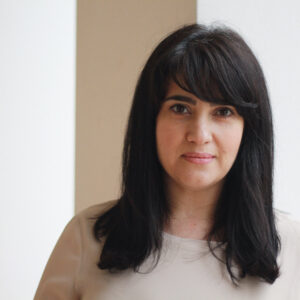
Marianthi Liapi is an architect and researcher specializing in the participatory upgrade of learning environments through the creative combination of design thinking and contemporary maker culture practices, using an interdisciplinary methodology she has developed called Educational Pla(y)ces. A Fulbright Outreach Ambassador and the winner of multiple awards and distinctions, she is the Research Program Director of the Transformable Intelligent Environments Laboratory (TUC TIE Lab) at the Technical University of Crete and was recently elected to the position of Assistant Professor at the School of Architecture in Chania. In this Q&A for Business Partners, she talks about her work, its impact, and her transformative experience with the Fulbright Program.
 As Research Program Director of the TUC TIE Lab, you work at the intersection of research, technology, and architectural design. How can research-driven design thinking contribute to public sector reform and generate measurable social impact?
Design thinking is a process where seemingly unrelated, diverse elements can be creatively composed into a new synthesis that better performs a new role and creates new value. It is a human-centered, iterative, and multidisciplinary process that goes beyond brainstorming to explore and produce useful, feasible, and viable solutions. This approach is particularly important in the design field, where everything should be reconsidered and reinvented in order to stay fresh and adapt to everchanging conditions.
We envision school environments where students feel they belong and teachers feel respected
This can be a paradigm for any reform since it handles a constant loop of evaluation and adjustment. In this sense, research-driven design thinking provides the agility to navigate a reform from bureaucratic, top-down decisions to participatory, bottom-up processes, investing at the same time in circularity, collectivity, and making.
Design thinking is one of the three pillars in TUC TIE Lab’s methodology, inherently connected with participatory practices and the maker mindset, to ensure that our research stays human-centered. This synergy has proven to be empowering for stakeholders in our projects, placing them in the decisionmaking process as creators and drivers of change, rather than just spectators.
You are currently leading a nationwide Ministry of Education initiative for classroom redesign, implemented through the TUC TIE Lab. How do such projects transform the educational experience in Greek public primary and secondary schools?
I would really like to utilize the resources of the Contemporary Learning Places program to help direct a shift from traditional, citadel schools to flexible, effective learning environments that will create a foundation for quality education for all. We have a shared vision in the lab to increase the pedagogical imprint of today’s learning spaces and facilitate the transition from a characterless school space to a learning place that supports wellbeing, social and emotional connections, agency, and safety, for both students and educators. In this sense, we envision school environments where students feel they belong and teachers feel respected.
The classroom is at the core of this change. The challenge is to implement design innovations inside the existing, one-size-fits-all, passive-learning classrooms. This aims to embrace spatial flexibility, to facilitate a variety of learning scenarios, and to provide comfort by securing proper lighting, acoustics, ventilation, and furniture. The classroom is viewed as an open-ended studio space, supporting diverse activities such as lectures, hands-on experimentation, and individual and group work. Furthermore, this multimodal space not only supports the learning activities of the curriculum but also favors a multitude of parallel programs, activities, and school initiatives.
Research-driven design thinking provides the agility to navigate reform while also investing in circularity, collectivity, and making
Tell us a little about your academic and professional mission and how this relates to career milestones, such as your new position in Chania or your leadership of the Ministry of Education initiative.
A few years ago, I came across a book by Karl De Schweinitz titled The Art of Helping People Out of Trouble, originally published in 1924. Through layers of Lakoffian metaphors, the author expresses his admiration for the art of helping, while encouraging people to prepare for the unexpected facets of life by equipping themselves with the skills of different roles. In my explorations, I have always strived to be useful and help people, not necessarily out of trouble, but to learn. It is a mission that has kept me on track, both in inspiring Aha! moments and in times of self-doubt. This new position expands my own explorations of helping people, students in this case, by sharing my knowledge and my experiences from which I have learned so far, and creatively challenging them in ways that will inspire them to evolve.
How has your experience as a Fulbright Student at MIT, and subsequently as a Fulbright Greece Outreach Ambassador, influenced your approach to innovation, collaboration, and leadership in Greece?
My experience as a Fulbright student at the MIT School of Architecture and Planning was essential in enabling me to develop a growth mindset and the attitude to experiment, create, and innovate. I became even more confident in my skills and abilities, and I equipped myself with an unrelenting urge to pursue and deliver pioneering projects that aim to challenge and change norms. This would not have been possible without the guidance of my mentor, developmental psychologist Edith Ackermann, whose definition of learning should be deeply carved in our minds: “Learning,” she wrote, “is less about acquiring or transmitting information or existing ideas or values than it is about collectively designing a world that is worth living in.”
Upon my return to Greece and inspired by best practice examples within the Fulbright network, I embarked on a mission, together with Kostis Oungrinis, to create an academic research and learning environment, continuously open and supportive to experimentation, failure, innovation, and creativity. This led to the establishment of TUC TIE Lab, home to more than 200 students and professional researchers so far and a source of inspiration to many others through its multidisciplinary, applied research programs.
How does strategic investment in educational infrastructure and spatial design contribute to Greece’s longterm competitiveness and sustainable development?
This is one of the macro goals of the Contemporary Learning Places program. Education plays a vital role in dismantling poverty and narrowing inequality. The documentation of research results around the world highlights that investments in education have a tenfold return in the long run. Beyond these economic advantages, education is profoundly responsible for improved public health and a stronger commitment to social engagement.
The proposed investment in school infrastructure aims to have even greater benefits, since classroom space in Greece has not changed for nearly 100 years. By providing spaces to foster all aspects of learning and by allowing students and teachers to create their own learning microcosms, we now have a great opportunity to create a solid foundation for education to cultivate creative citizens, which in turn is a key parameter for innovation and competitiveness. Even more, the new classroom will operate as an ecosystem, enabling a better understanding of all dimensions of circularity and leading to much wanted sustainability awareness.
For more information visit www.fulbright.gr