

 AmCham Greece’s vital new initiative brings together policymakers and industry leaders to map out a blueprint for Greece’s growth and prosperity in the years ahead.
As Greece continues to build on its impressive momentum, the conversation around its economic future cannot be limited to fiscal stability alone. Anchored in the belief that sustainable growth requires a deeper, more structural transformation, the American-Hellenic Chamber of Commerce recently launched its Blueprint Greece 2030: Next Generation Reforms initiative. This strategic dialogue series aims to serve as a platform for high-level dialogue between senior members of government and the business community to highlight necessary reforms and formulate actionable policy proposals needed to secure the nation’s growth trajectory and strengthen longterm competitiveness and prosperity.
To translate the remarkable progress it has achieved in recent years into sustainable, longterm competitiveness, Greece must push forward with targeted reforms to boost productivity, enhance the investment environment, accelerate innovation, and make the public sector both friendlier and more efficient. Tomorrow’s leading economies will be those that combine fiscal stability with institutional efficiency, a capable workforce, innovation, and investment attractiveness.
– John D. Saracakis, President, AmCham Greece
The insights from this series will be compiled in a comprehensive position paper titled “Next Generation Reforms for Greece: Priorities for Competitiveness, Investment, and Growth,” which will serve as a blueprint for future public policy advocacy, ensuring that talent, technology, and economic strategy remain aligned to position Greece dynamically on the global stage.
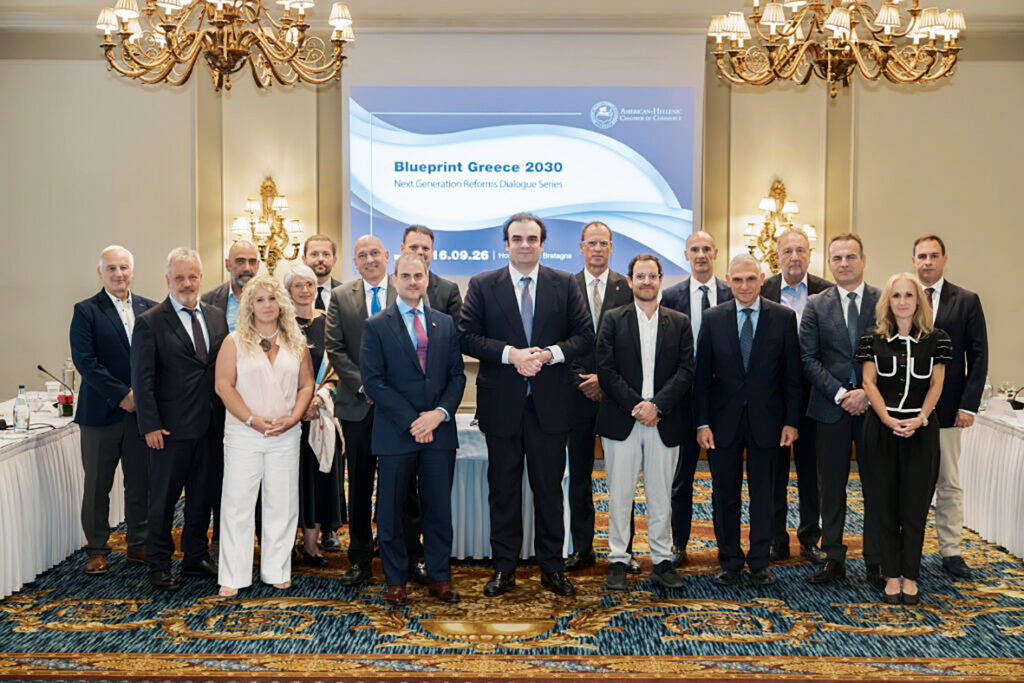
Blueprint Greece 2030 kicked off on September 16, 2026, with closed meetings with Minister of Labour and Social Security Niki Kerameus and Minister of National Economy and Finance Kyriakos Pierrakakis. Held at the Hotel Grande Bretagne in Athens and attended by select C-suite executives from the AmCham Greece network, the invitation-only sessions focused on the next generation of reforms needed to strengthen Greece’s longterm competitiveness.
The Future of Work 2030: Talent, Skills and Labor Market Transformation
Focused on the comprehensive labor market transformation required by 2030, the discussion with Minister Kerameus looked beyond basic employment figures to address workforce quality, upskilling, and reskilling. Participants analyzed structural ways to attract and retain high-caliber human capital, improve productivity, and build a resilient workforce capable of driving economic competitiveness.
Fiscal Competitiveness and Growth: Building Greece’s Economy for 2030
Centered on the next generation of fiscal and economic reforms, the discussion with Minister Pierrakakis examined key strategic focus areas including attracting high value-added investments and expanding access to capital markets, accelerating the digital transformation and improving public sector efficiency, and fostering innovation, research, and infrastructure modernization to build a robust foundation for longterm growth.
Labor Market and Policy Insights
with Minister of Labour and Social Security Niki Kerameus

On the impact of AI on work
While certain legacy positions will naturally decline as a result of AI, other professions will evolve and entirely new career categories will emerge. The key is horizontal investment in upskilling and reskilling to develop an AI-literate workforce capable of fully deploying new digital applications and adapting to change.
On stronger academia-industry pipelines
Fully utilizing available tools can help resolve skills shortages and address youth unemployment; this includes expanding Vocational Apprenticeship Schools, increasing curriculum-linked internships, and developing targeted professional master’s programs to match curricula to real-world corporate needs.
On new tech adoption by SMEs
Micro-enterprises form the backbone of the economy, yet with approximately 90% of Greek businesses employing fewer than 10 workers, they also pose a structural fragmentation challenge. The state must work closely alongside social partners to actively support smaller businesses in adopting and deploying new technologies.
On the demographic shift
The demographic crisis is by far Greece’s most severe longterm challenge, with declining birth rates slowly shifting the country’s needs and priorities. While no country has been able to fully resolve this issue to date, modern fiscal family policy and tax incentives are vital tools in this effort.
On rethinking pedagogical frameworks
The cognitive development of younger generations is a major issue. The reintroduction of mechanisms for school evaluation and improvement alongside modern textbooks and new educational pathways will help steer education away from rote memorization, favoring the development of critical thinking and analytical skills.
On the Greek labor market in 2030
The goal is to not only increase the number but also the quality of jobs, with more specialized positions and better wages.
Economy and Innovation Insights
with Minister of National Economy and Finance Kyriakos Pierrakakis
On enhancing the business environment
Driving increased productivity and longterm competitiveness requires cutting red tape and securing a stable, predictable environment that allows businesses to invest capital and grow.
On radical capital integration
The Savings and Investments Union is one of the most obvious and most radical reforms Europe needs today. Deeper integration of capital markets and the banking system can give a significant competitive boost by creating larger European financial institutions capable of financing investments and technology.
On aligning priorities
Having learned from the experiences of the previous decade, Greece is keen to make up for lost time. This necessitates a broader political discussion including the opposition. The more we converge on what needs to be done, the greater the country’s potential to move forward.
On a European regulatory framework for AI
Greece’s ongoing, extensive digitalization confers significant prestige and capabilities in the new technological environment. What is needed now is an EU framework that protects European interests without restricting innovation, growth, and our ability to attract investments.
On the future of the euro
In the period ahead, there will be movement toward greater monetary integration in Europe. There are significant elements of protection and stability that stem from participation in such a monetary family. A further expansion of the eurozone will both strengthen the international footprint and the role of the euro.
On securing the country’s growth trajectory
To improve competitiveness and attract investments, Greece must accelerate technology adoption, scale businesses, and keep energy costs in check. We must prioritize reforms that unlock the country’s growth potential, including digital upgrades, productivity enhancements, and AI integration.