

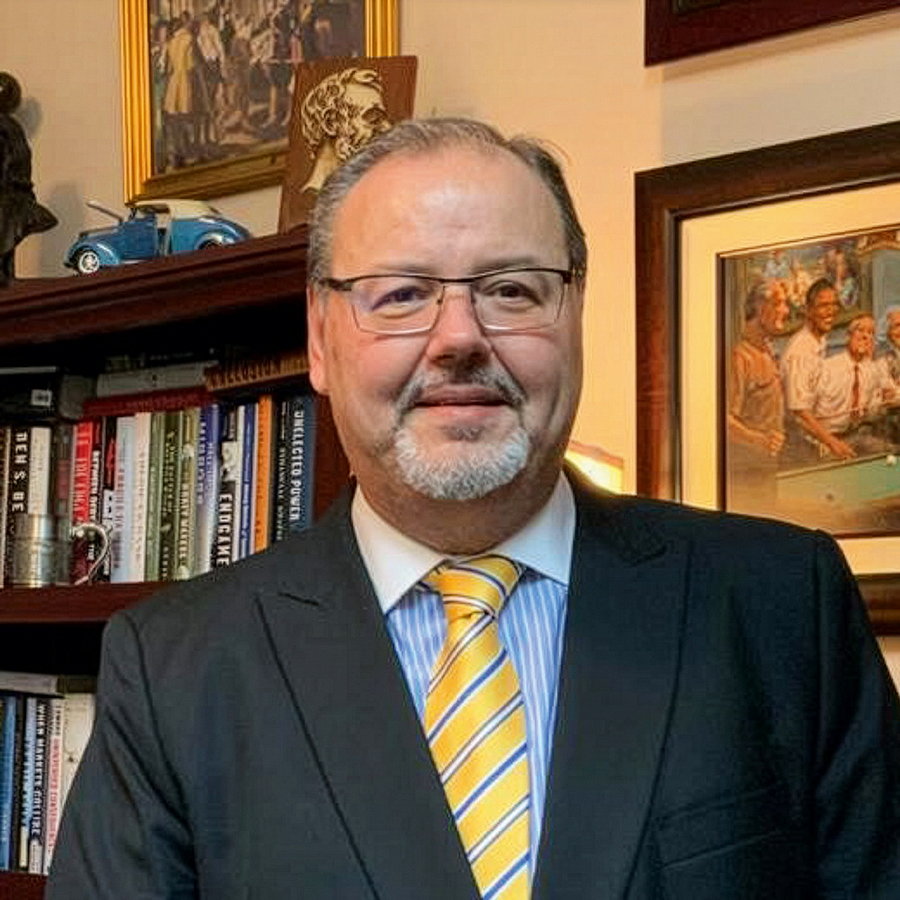
Dr. John E. Charalambakis, Managing Director of BlackSummit Financial Group—a firm at the intersection of transatlantic investment, economic policy, and strategic advisory—talks to Business Partners, about navigating uncertainty, the lessons we can learn from the past, and the future of US–Greece economic collaboration.
How is BlackSummit’s role as a boutique global advisory firm evolving in today’s volatile macroeconomic environment, particularly with respect to US-Europe strategic economic partnerships?
In today’s environment of geopolitical volatility and economic fragmentation, I see BlackSummit’s role becoming even more crucial. Our firm stands out because we have a global-macro perspective and are committed to educating our clients by analyzing the trajectories of geopolitics, economics, and financial markets, along with emerging trends that are reshaping our world, from AI to climate change. BlackSummit consistently emphasizes understanding systemic risks—whether they stem from geopolitical rupture, weakening multilateralism, or market imbalances—and that’s exactly what clients need as uncertainty grows and the US–Europe relationship becomes increasingly fragmented.
Greece needs to identify its key competitive advantages and trade on them
We believe the world is entering a phase of political and economic rupture, marked by unsustainable debts, overvalued segments of the market, lack of solid collateral, rehypothecation of assets, weakened multilateralism, geopolitical flashpoints, and rising barriers to economic cooperation, all of which are complicating US–European relationships. Our firm’s network across the US and Europe, and our ability to blend macroeconomic insight with tailored guidance, makes us a valuable partner in navigating this ever-changing landscape.
How do your Ph.D. in Economics and your work as a professor inform your approach to portfolio strategy and risk assessment?
Our lives need anchors. Our politics cannot survive without anchors. Our institutions are shaky without anchors. Portfolios without anchors are susceptible to crashes. Corporate strategies without anchors are worthless. Our message is simple: Where is your anchor, and how strong is it with the incoming storms?
Teaching is a joy because students bring to the classroom many experiences and wonderful lessons. I try to humbly approach teaching with the motto: “I don’t have answers. I only have questions for your answers.” Unfortunately, around the world, the capacity to think is deteriorating. The ability to integrate disciplines and be truly educated, rather than merely trained, is disappearing. Decades of teaching economics has trained me to think in terms of how shocks emerge, where vulnerabilities accumulate, and how structural forces from all sides shape the future. At BlackSummit, we start with a big-picture analysis of macroeconomic risks before making any portfolio decisions. Researching and teaching topics such as financial crises and monetary regimes has taught me that risks often build quietly at the margins, where very few people are watching. This is why BlackSummit emphasizes hedging and anchoring in real assets that are no one else’s liabilities.
Your knowledge has resulted in you assisting the US Congressional Financial Crisis Inquiry Commission with research on the causes of the financial crisis. What lessons from the past would we be wise to heed today?
In 2003, I published an article predicting the housing crisis and the bankruptcy of Fannie Mae and Freddie Mac. The writing was on the wall. We had accumulated liabilities around the world to the tune of $300 trillion, up from $50 billion in 1996. It was like we’d built a condominium tower with foundations for five floors and were looking down from the 50th-floor penthouse, admiring the view. My suggestion was: “Get out. This tower will collapse. I don’t know when, but I do know that it is coming down.” By mid-2007, those liabilities had increased to over $720 trillion. Then, the market crashed. That was the essence of my contribution to the US Congressional Commission.
Today, those liabilities are just a little less than $700 trillion. Let readers decide how sustainable the situation is.
Tell us a bit about the major infrastructure and strategic assets projects that BlackSummit has been involved in in Greece.
Former Fed Chairman Paul Volcker (the best chairman of the Fed) taught several things, but two of the most important lessons he taught me are: First, policies without anchors always backfire; and second, projects should always advance national interests before personal interests.
BlackSummit treats major infrastructure as both an economic asset and a geostrategic pillar. Our initiatives in the region—such as the acquisition and operation of the Port of Kavala in Greece—illustrate how infrastructure sits at the crossroads of national security, trade security, food security, and energy diversification. These projects are designed explicitly to support Western‑aligned economic and security objectives, including diverting trade away from adversarial chokepoints and strengthening NATO‑friendly logistics networks.
In evaluating that intersection, I look at how economic policy increasingly shapes which infrastructure projects become strategically viable, because today, ports, pipelines, and energy corridors are not just commercial decisions; they’re policy‑driven responses to geopolitical competition. BlackSummit’s projects deliberately strengthen Western strategic influence by strengthening corridors for energy security, food security, and regional military security, and are built to advance a rules‑based, transatlantic economic architecture in regions exposed to Chinese and Russian influence.
BlackSummit was one of the first companies to join AmCham Greece through its new office in Washington DC. What opportunities do you see for strengthening US–Greece business relations and transatlantic investment?
I see major opportunities to strengthen US–Greece business ties by turning the Chamber’s DC office into a strategic bridge for policy, investment, and sector‑level collaboration. The new office was created to deepen bilateral trade and investment at a moment of historically strong US–Greece relations and to serve as a gateway for companies expanding in either market. BlackSummit can contribute by translating policy priorities—energy security, infrastructure modernization, supply‑chain resilience—into actionable projects. Our work on ports, LNG corridors, and carbon exchanges across Greece and the Balkans directly supports US goals of strengthening regional infrastructure and trusted supply chains. Finally, by leveraging AmCham’s networks in DC, we can help organize US capital into Greek strategic assets and guide Greek companies entering the US market, reinforcing a durable transatlantic economic partnership.
Greece needs to identify its key competitive advantages and trade on them. Those advantages have to be unique and with barriers to entry. However, advancing those advantages without a solid wholistic educational background that trains future minds in the business of integrating different fields of studies may produce only ephemeral gains and not bear longterm benefits that sustain societies and nations.
Which are the key macroeconomic trends or market dynamics to monitor most closely in the coming time?
First, the pace of geopolitical change. The speed—not just the direction—of political shifts is driving markets in ways we haven’t seen before. When the second derivative of geopolitics accelerates, everything from oil to credit can be repriced overnight. Second, I’m tracking global imbalances and the early tremors showing up in markets. We’re seeing precious metals spike, emerging markets outperform, and even Japan’s bond market showing stress. Those are classic signs that the system is absorbing shocks unevenly, and they often foreshadow bigger moves ahead. Third, the rates story remains front and center, and the independence of the Fed is at stake. Even with Fed cuts, longterm yields have stayed stubbornly high, and the dollar is weakening. And finally, AI spending. There’s a real question about whether the massive capex going into AI will translate into sustainable earnings, and in general, we are seeing overvaluation in a number of segments in the markets. While market analysts broadly expect 2026 to be a strong year for equities, we remain more cautious, and we would not be surprised if recession risks materialize by late summer or early fall.