
As Managing Director of Merck in Greece and Cyprus, Fabrizio Bocchetti brings international expertise and people-first leadership to the country’s dynamic life sciences and pharmaceuticals industry. Since assuming his role in April 2025, he has guided Merck’s operations with a clear focus on innovation, sustainability, and fostering a positive workplace culture. Under his leadership, the company has not only strengthened its position in the market but also earned recognition for its employee wellbeing and safety initiatives, reflecting his commitment to both people and progress.
In this interview to Business Partners magazine, he shares insights into his leadership philosophy, the evolving Greek pharmaceutical landscape, and the pivotal role of collaboration, innovation, and the next generation in shaping the future of healthcare.
What are some of the formative influences that shaped your leadership style over the course of your career, and how do these inform the way you lead today?
Throughout my career, I have had the privilege of working across different business contexts within the life sciences and pharmaceutical industry, gaining experience in environments ranging from strong growth phases to complex transformation moments. These roles shaped my belief that leadership is not about control, but about clarity, trust, consistency, and flexibility.
I have been particularly influenced by leaders who combined strategic rigor with genuine attention to people and by mentors who demonstrated that sustainable performance comes from empowering teams, setting clear priorities, and remaining resilient under pressure. Observing how they navigated uncertainty, made courageous decisions, and stayed true to their values left a lasting mark on my own leadership approach.
Leadership is about clarity, trust, consistency, and flexibility
In my current role, I foster a culture of accountability, openness, and shared purpose, creating the conditions for people to perform at their best while ensuring that our strategy remains anchored in longterm value creation for our patients, our partners, and the healthcare ecosystem. I actively encourage collaboration and innovation, recognizing that the best ideas can emerge from diverse perspectives and collective problemsolving.
By focusing on trust and communication, I aim to create a resilient organization that can thrive during changes, ensuring we stay focused on our mission to improve lives while dealing with the challenges of the healthcare sector.
Taking a people-first approach is a strategic choice that enables sustainable performance
Tell us more about your people-first approach at Merck Greece and how you translate core leadership values into practical management practices.
My leadership is guided by a commitment to the values of trust, accountability, inclusion, and purpose. A people-first approach, in my view, is not about being soft; it is a strategic choice that enables sustainable performance.
Values matter only when they shape everyday decisions. This is why we translate them into very practical management behaviors. Trust becomes empowerment, with decisionmaking pushed as close as possible to the teams. Accountability means clarity on priorities and expectations, combined with open and timely feedback, high standards and people-centric leadership. Inclusion is practiced through listening and dialogue, creating spaces where diverse perspectives genuinely influence decisions.
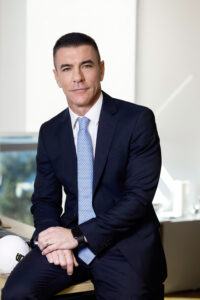 As General Manager, my responsibility is to cultivate a culture where business impact and human sustainability reinforce one another. When this alignment is genuine, we not only meet our performance goals but also ensure that our success lasts over time. By focusing on our people and integrating our values into all our management practices, we are building a strong organization that can handle the challenges of the healthcare landscape while staying committed to improving lives.
Merck Greece recently received recognition for its employee wellbeing efforts. What specific programs or management strategies do you attribute this success to?
I am deeply honored that our team in Greece received the Gold Award for “Employee Wellbeing Initiatives” at the Health and Safety Awards 2025. This recognition validates a fundamental management philosophy: that sustainable business performance and employee wellbeing are mutually reinforcing.
Our approach began with genuine listening and actively engaging with younger employees, particularly through our FutURe Project, which produced actionable insights on critical issues around emotional wellbeing and family planning. What emerged was clear: Today’s workforce seeks employers who support them holistically, especially during life’s most significant moments. In response, we introduced a comprehensive suite of initiatives that includes:
Future Ways of Working, a flexible work program that enables employees to balance professional and personal responsibilities; a pioneering Fertility Benefit, providing educational resources and financial support for fertility treatments regardless of family status or sexual orientation; the Moments that Matter program, offering dedicated paid leave for adoption, foster care, and caregiving, ensuring no one has to choose between career and family responsibilities; and the BeHealthy program, promoting physical and mental health with flexible participation options.
The results speak through multiple dimensions: higher employee engagement scores, stronger retention rates, improved collaboration, and a culture where innovation thrives because people feel psychologically safe to contribute ideas. Not least, we see it in the everyday reality of our workplace—employees who bring their whole selves to work because they know the company supports their whole lives.
How is sustainability integrated into Merck’s strategy in Greece, particularly regarding social challenges beyond environmental concerns?
Sustainability at Merck is a key priority. We create longterm value through our core business practices while balancing environmental, social, and governance aspects—for us, for our stakeholders, and for society at large. Our strategy is built on three interconnected pillars: planet (reducing our ecological footprint); people and processes (partnering for sustainable business impact); and products (advancing innovation for humanity). We focus on driving health equity for underserved populations—as half the global population lacks adequate access to health—by delivering innovations in science and technology, building infrastructure, ensuring affordability through equitable pricing mechanisms, and collaborating with diverse partners.
What makes our approach distinctive in Greece is how we integrate sustainability with genuine youth engagement and social responsibility. We actively integrate their voices into our strategic direction through the FutURe Project, which features three key components: Our FutURe Barometer youth surveys, which allow data-driven understanding of young Europeans’ needs, priorities, and concerns; our FutURe Roundtables, where young professionals share relevant insights and proposals that are then used to inform real strategy; and our Internal Advocacy Platform, which empowers young employees by bringing them together with senior management to discuss challenges and co-create solutions.
Within our sustainability framework, we’ve identified two critical focus areas that directly address Greece’s societal challenges: One is Belonging and Inclusion, ensuring young professionals feel valued, heard, and empowered to shape the future, and the other is Closing the Fertility Gap, addressing Greece’s severe demographic challenge.
Our FutURe Barometer research reveals the urgency: While 76% of young Greeks feel informed about birth control, only 45% understand factors influencing fertility, and just 34% know about egg freezing. Alarmingly, 63% report frequent emotional distress—the highest rate in our European survey—with 70% citing stress as the primary factor impacting fertility.
As a company with a leading position in fertility treatment since 1906, we believe Greece must make fertility a national priority. Our integrated approach combines employee support through our Fertility Benefit, policy advocacy through evidence-based recommendations to Greek authorities, public awareness campaigns, and ongoing dialogue with young Greeks about barriers to family planning, demonstrating that sustainability, youth engagement, and addressing demographic challenges are interconnected elements of a comprehensive strategy that creates value for our employees, our business, and Greek society as a whole.
How do you view the current landscape of the Greek pharmaceutical market?
The Greek pharmaceutical market operates under significant structural pressure, primarily driven by chronic underfunding of public pharmaceutical expenditure. While most sectors affected by the financial crisis have gradually recovered through increased national budget allocations, pharmaceutical spending has remained largely static at around €2.6 billion for over a decade, despite market demand exceeding €8 billion.
This funding gap is further complicated by a paradox highlighted by the Hellenic Association of Pharmaceutical Companies (SFEE): During periods when unemployment reached 22% with higher numbers of uninsured citizens, pharmaceutical expenditure for their coverage was approximately €150 million. Today, despite claims that unemployment has decreased to 8%, expenditure for uninsured patients’ medications has skyrocketed to €360 million, revealing fundamental distortions in how the pharmaceutical budget is funded and managed.
Beyond funding constraints, additional challenges relate to volume growth, prescribing dynamics, and system inefficiencies. Yet despite challenges, Greece offers meaningful opportunities. The country has strong potential to expand its role in clinical research and accelerate digital health adoption. However, unlocking this potential requires a more balanced and predictable framework.
Innovative medicines in Greece are priced among the lowest in the Eurozone, but companies must cover over 80% of extra costs through rebates and clawbacks. This model is not sustainable and does not encourage investment. To create a more sustainable healthcare system, we need to reduce total costs while increasing public funding, with shared responsibility to address discrepancies.
How significant are partnerships with organizations such as AmCham Greece and SFEE in driving business growth, public policy discussions, and patient access?
Memberships in organizations such as the American-Hellenic Chamber of Commerce and SFEE are highly significant for Merck Greece, not only in supporting business development but also in shaping a more structured and forward-looking dialogue around public policy, innovation, and patient access.
The value of AmCham Greece lies in its ability to serve as a bridge between international business, local industry, and policymakers. Its strong transatlantic perspective and institutional credibility allow critical topics—such as healthcare sustainability, investment attractiveness, and innovation—to be discussed in a constructive, solution-oriented way, rather than through fragmented lenses.
A clear example of this impact is the Chamber’s role in facilitating dialogue on healthcare investment, clinical research, and digital transformation, helping position Greece not only as a consumption market, but as a potential hub for high-value, innovation-driven investments. These platforms create the conditions for companies like Merck to engage more effectively with stakeholders and align on longterm priorities that ultimately benefit patients.
Looking ahead, I believe business associations can further strengthen their role by continuing to promote predictability and transparency in policy frameworks, encouraging evidence-based discussions on pharmaceutical expenditure and value, and fostering cross-sector collaboration between industry, academia, and healthcare institutions. When associations operate as strategic partners in shaping the ecosystem, they become powerful enablers of sustainable growth and improved patient access.
For Merck, this type of collaboration is essential to advancing our initiatives in Greece while contributing to a healthcare environment that is resilient, innovation-friendly, and aligned with international best practices.