

From the late 18th century, as ships sailed across vast oceans in pursuit of exploration and trade, the difference between safety and disaster often depended on a few seconds of time. Determining a ship’s longitude required knowing the precise time at a fixed point—usually Greenwich, England—and comparing it with local time at sea. The device that made this possible was the marine chronometer, a masterpiece of mechanical precision that turned time itself into a navigational instrument.
Among the makers who mastered this delicate art, one American name stood out: William Bond & Son of Boston. Their chronometers were not just instruments; they were emblems of a young nation’s growing command of science, engineering, and global reach, and their steady ticking signaled both craftsmanship and confidence, the essence of America’s emerging technological identity.
Craftsmanship and Curiosity
The story began in 1807, when English-born William Bond opened a small shop in Boston, establishing himself as a watch- and clockmaker. At a time when precision timekeeping was dominated by British makers, Bond’s ambitions were remarkable. He soon partnered with his son, William Cranch Bond, an equally gifted craftsman whose interests extended into astronomy and physics, and soon their partnership gave the company its enduring name: William Bond & Son.
Their chronometers, regulators, and astronomical clocks were built with extraordinary attention to accuracy. Many of their marine chronometers incorporated fine English movements—by Earnshaw, Frodsham, or Barraud—finished, adjusted, and tested by the Bonds in Boston. What distinguished their work, however, was not imitation but interpretation: a distinctive American insistence on practical reliability and empirical verification.
That same philosophy guided William Cranch Bond’s later career as the first director of the Harvard College Observatory, where precision timekeeping became the foundation for astronomical observation. There, the Bond family helped pioneer one of America’s earliest electrical time distribution systems, synchronizing clocks through telegraphic signals—an innovation that foreshadowed today’s networked timekeeping.
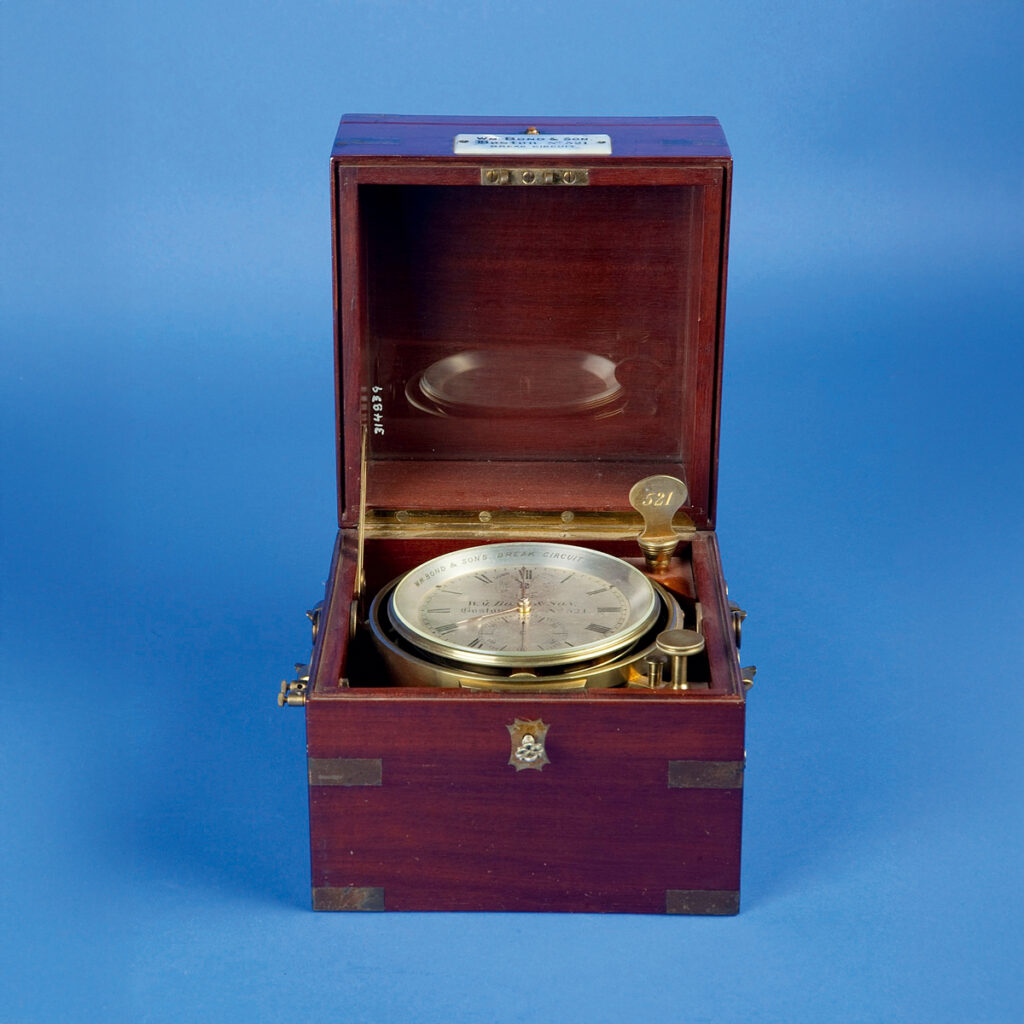
William Bond & Son marine chronometer in box, c. 1870 – National Museum of American History, Smithsonian Institution
Instruments of Navigation, Symbols of Trust
At sea, a Bond chronometer represented far more than a technical device. Enclosed in its gimballed brass case and mahogany box, it was an object of near-reverence. Captains relied on it to calculate their position, chart routes, and survive storms or fog. Every day, the officer of the watch wound it at precisely the same hour, ensuring continuity and care. To fail in its maintenance was unthinkable: A chronometer’s reliability was synonymous with the crew’s safety.
Innovation, at its best, is both measured and meaningful
William Bond & Son supplied chronometers to US Navy vessels, private shipping lines, and even scientific expeditions. Indeed, one of their instruments accompanied the United States Exploring Expedition of 1838-1842, contributing to early American efforts in hydrographic mapping. The chronometer thus became a quiet participant in the expansion of both commerce and knowledge, a companion to the compass, sextant, and chart in defining the contours of a new world.
The Bond Legacy
The Bonds’ achievement lay not only in their mechanical skill but in their understanding of time as an infrastructure of progress. They bridged the craft era of horology with the scientific age of standardization, laying the groundwork for a culture of precision that would later define American manufacturing, railroads, and communications.
Over the decades, as the firm evolved into William Bond & Sons and later William Bond & Co., their instruments found places not just on ships but in observatories, banks, and government institutions, where the accurate measurement of time underpinned trade, finance, and coordination. The Bond name became a benchmark for integrity: If a clock bore that inscription, it could be trusted.
This legacy extended into new domains. The synchronization of clocks across cities enabled railway timetables and telegraph networks. The precision culture pioneered by chronometer makers informed the industrial systems that would later define the American century. Every tick of a Bond chronometer was, in a sense, a rehearsal for the synchronized hum of modern infrastructure.
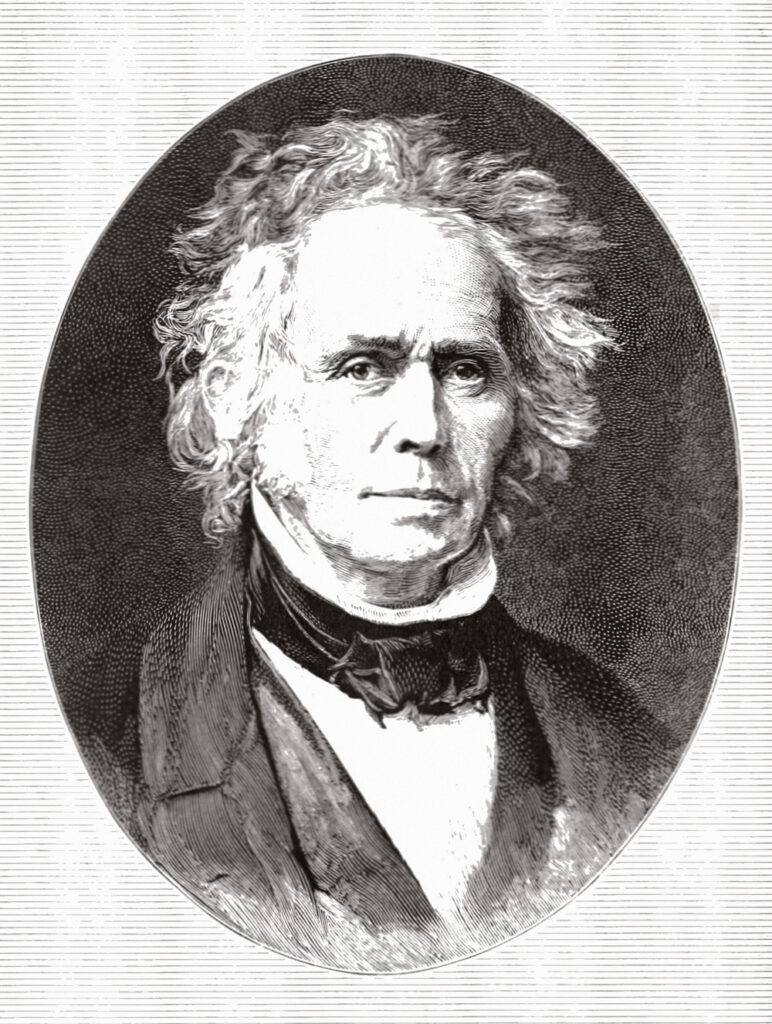
William Cranch Bond, 1789-1859
Precision and Innovation: A Timeless Equation
The marine chronometer’s purpose—to maintain unwavering accuracy in motion, amid salt air and shifting seas—embodies the same challenge that innovators face today: how to achieve stability within change. Whether in global logistics, digital communications, or data synchronization, the principles remain remarkably consistent.
Modern technologies such as GPS navigation and atomic clocks carry forward the chronometer’s legacy on a new scale. Satellites orbiting Earth now provide the same essential function once performed by Bond’s brass instruments—linking location to time with unerring precision. The transition from mechanical to digital timekeeping has altered the medium, but not the mission: the relentless pursuit of accuracy as a foundation of trust.
In that sense, the Bond chronometer is not merely an antique. It is a reminder that innovation, at its best, is both measured and meaningful. The chronometer’s beauty lies in its balance—between art and science, movement and control, exploration and certainty. These same balances define the ethos of modern enterprise: the ability to navigate uncertainty through disciplined precision.
A Living Heritage
Today, a few William Bond chronometers survive in museums and private collections, their brass still gleaming, their escapements still capable of beating with remarkable accuracy. They stand as artifacts of an age when craftsmanship, curiosity, and courage converged to shape the modern world.
For America, they symbolize something enduring: the belief that progress requires both imagination and exactness and that innovation is not only about invention but about refinement. The Bonds were not just watchmakers; they were architects of time itself, translating the rhythm of a pendulum into the cadence of a nation’s advance.
As we navigate the complexities of the 21st century, from global supply chains to space exploration, the story of William Bond & Son reminds us that every era’s frontier begins with a simple question: What time is it?
And in answering it with precision, humanity charts its course forward once again.